


Have you seen the new book? Just released Oct 4/2011, 138 pages of details! 2012 Sprinter RV Buyer's Guide

Welcome to the Sprinter RV blog!

I started it when we built our Sprinter RV conversion, an all-diesel and solar-powered Sprinter camper van. Now I've also written the Sprinter RV Conversion Sourcebook and the Sprinter RV Buyer's Guide to help you build or find your own Sprinter RV. I hope you find it useful reading! Greg Keith

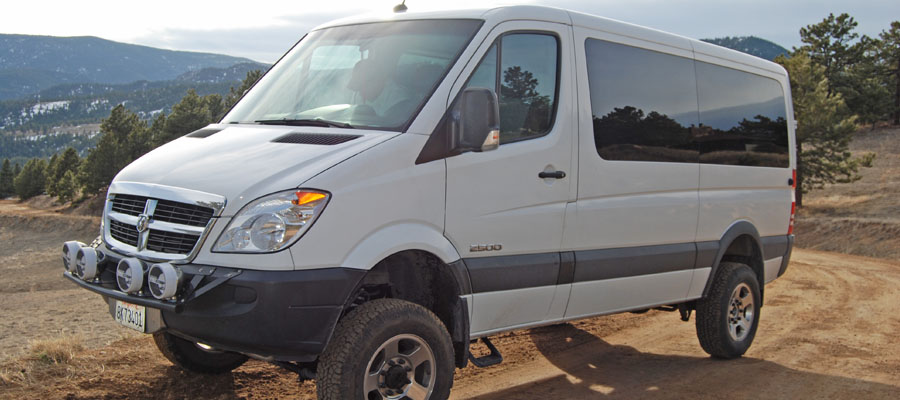
4x4 Sprinter by WhitefeatherLast month I had the good fortune to drive the first production North American 4×4 Mercedes Sprinter, after the initial Sportsmobile and Sportsvan prototypes. Jim Bageman, on a cross-country tour with Whitefeather Conversions‘ Sprinter 4×4 van, stopped by and let me play with this sweet toy, a 4×4 Sprinter conversion using a 2007 144″ WB Sprinter 2500 low-roof cargo van.

Unseasonably fine weather meant I had more steep, loose, washboard roads to drive the van on than the muddy, icy streets that usually abound in Boulder this time of year. The van was very composed on the steep track I set it on, nimbly powering its way around soft-shouldered corners without any drift. The suspension feel is very firm, but not overly harsh – though the Whitefeather conversion keeps the stock Koni front struts and shocks, a burly reinforced coil spring mount is welded into each front wheel wheel and attached to the subframe. Adjustable Rancho shock absorbers on the rear axle allow you to adjust the ride for stiffness or heavy loads. The 4.5″ increase in ride height on the van I drove is 1″ higher than the stock 3.5″ increase in ride height for the typical conversion, but didn’t seem to generate any instability (although I didn’t drive the van at highway speeds).

Craig Jackson, one of the founders of Whitefeather, has lots of experience with 4×4 Sprinter conversions from his days with Salem-Kroger. What does Craig think are the best features of the Whitefeather 4×4 Sprinter conversion?  ”The strong points of the Whitefeather design are that:

  • we build our conversion using easy-to-find parts
  • the Sprinter still scans as a stock vehicle
  • the Sprinter engine and transmission remain stock and unaltered
  • the ride quality is comfortable
  • the cornering ability is better than stock
  • we can adjust shock rates, sway bar sizes and even vehicle height to meet specific customer requirements while maintaining the same basic proven system
  •  Whitefeather Conversions intended for the US market are all US DOT legal.”

Here’s some pros and cons I observed during my brief time with the van. The pros:

  • Very tight steering
  • Almost zero lean and body roll, helped by the heavy-duty front and rear anti-sway bars
  • Reliable 4×4 mode selection using manually locking hubs (optional front air lockers)
  • Smooth 4WD mode selection with long-throw floor shifter
  • Very beefy new front subframe of heavy-gauge steel

The cons:

  • Conversion adds almost 500 pounds to vehicle weight
  • $20,000 additional cost

There’s plenty of 4×4 Sprinter conversions rolling out of Whitefeather’s Red Bluff, California, shop. What if you’re not in California? Patrick Struhs, Sprinter sales manager for Warner Truck Center in Salt Lake City, the largest Sprinter dealer shy of the West Coast, says he’ll be stocking some: “We have arranged to purchase one of the Whitefeather Sprinter conversions, and depending on interest, we may buy more.” What’s Pat’s opinion of the Whitefeather conversion? “We brought it back into the shop and the mechanics, all the mechanics, went nuts over it. They thought it was really well-built. Of course, the fact that it uses readily-available Ford 4×4 conversion parts is another big plus, since those parts are easy to get and lots of folks know how to work with them.” Pat is also impressed with the way the Whitefeather 4×4 Sprinter handles, having driven it up to Park City to show some potential customers. Warner Truck Center has been selling Sprinters since 2002, so Pat has seen his fair share of Sprinter vans.

This Whitefeather Sprinter van is off to New Jersey to be examined by Mercedes-Benz executives. Will Daimler Vans USA give its stamp of approval to the Whitefeather Sprinter conversions, rather than (or in addition to?) importing factory-modified Mercedes 4×4 Sprinters into North America? It’s anyone’s guess, at this point.


Gallery – Whitefeather 4×4 Sprinter Conversion

4x4 Sprinter by Whitefeather, front view 4x4 Sprinter by Whitefeather, front suspension 4x4 Sprinter by Whitefeather, reinforced front struts
4x4 Sprinter by Whitefeather, new steel subframe 4x4 Sprinter by Whitefeather, modified rear suspension with adjustable Rancho shock absorbers 4x4 Sprinter by Whitefeather, rear view

ASKING YOUR FEEDBACK: Would you pony up the extra $20K for a 4×4 Sprinter conversion, get an E350 4×4 instead, or will you wait for an official Mercedes 4×4 Sprinter to come to North America?

Sprinter DIY conversion by Allen Sutter

MOAB, UTAH – We had gathered to ride the “Magnificent Seven”, a mountain bike trail that’s 35 miles of slickrock heaven. En route, our shuttle bus stopped so we could park our Sprinter van, and I saw Allen Sutter duck into his Sprinter camper for some gear. By the trailhead, we had discovered we were both Canucks, avid mountain bikers, and loved our Sprinter RVs!

Allen did his own Sprinter DIY conversion, though when you look at the pictures, you’ll realize “DIY” may not be the term that comes to mind. Allen happens to be a professional cabinetmaker, and the owner of Sutter Fine Woodwork, and specializes in high-end residential custom cabinetry. His design reflects this, with tons of beautifully-crafted cabinets inside, as well as having lots of interior LED lights and a rear “bike garage” with slide-out bike drawers. Perhaps the most unique feature is that the entire interior is completely removable in about two hours with a power screwdriver!

I asked Allen about his Sprinter conversion, and the ins and outs of his DIY Sprinter camper.

What were your major design goals? ”We wanted a gourmet kitchen with a generous refrigerator, a very comfortable full-time bed, lots of light, lots of storage and a garage for bikes and other gear.”

Did you end up doing several designs, or just one? ”I went through a few arrangements until I came up with a plan that worked for us. I don’t start construction on any project until the details are nailed down and the only adjustments were in the fitting.”

About how long did the conversion take you to design and build, and roughly how much did it cost? ”About two months beginning to finish, including insulating. Most of the materials I used were leftovers from jobs and inventory items. Because of this, my costs would differ from the average person doing the same conversion.”

What are the features of the design that you feel turned out the best? ”Everything worked just as we wanted and expected. The Atwood cooktop has a fantastic temperature range. Cooking with gas (propane) is so controllable that if you do a lot of fine cooking (which my wife would not compromise on), it is indispensable. Unfortunately, this means carrying propane, but we found it was worth the trouble. The little pullout step for getting into the bed also worked well as another seat…Having the two stacked storage bins by the sink pull out for seat bases and the cushions stored under the sink by the trash made for very efficient dual use and worked well for both. With the flip-up tables and seat arrangement we had dining with a view. It was good to have the only window located in the side door so that the space could be used to maximum efficiency and insulated more completely.”

What are the things you wish you’d done differently? ”I will do these changes in the new version:

  • Solar power system or fuel cells, can’t decide which but cost may determine the choice. We were just running off the van’s auxiliary battery, but if we were not driving regularly we would run out of power and have to use a generator (we don’t see that as a good option).
  • May go to an electric water pump and demand heater, even though the hand pump faucet worked well and heating water on the stove was efficient enough, once we established a routine. May just keep it light and simple too.
  • Frame and panel doors and large drawer fronts, instead of one-piece, to reduce weight.
  • The upper cabinets will be attached to the lower units so that the construction is even more unified for ease of installation and removal and even some added safety.
  • Modify the fastening system (cabinets to van) to make the installation/ removal process more efficient and have better longevity with repeated assembly and disassembly.
  • Marine LEDs which are not as finicky as interior LEDs which have to be voltage-regulated. The marine LEDs have a broad voltage range, so the whole system can be much simpler and more efficient than the home system I used.
  • Try to make it lighter. We are close to the rated weight capacity of the van now and want to keep it as low as possible without compromising our priorities.
  • Remove the rage hood. It drew too much power and was redundant with the roof fan anyway…. will just use a heat deflector.
  • Organize the garage a little better, get rid of the gravity filter (too slow) and go to a hand pump ceramic filter for stream water instead and keep the sediment/ carbon/ UV system for town water, will adjust shelving and tie-downs as necessary.
  • 120 litre stainless steel water reservoir (upgrade from 60 litres)
  • Different latch system, possibly central lock-down. Too often, we would forget to latch a drawer and it would fly open while making a sharp turn.
  • Will add a catalytic heater, since we need propane for the cooktop anyway.
  • Still on the fence about an awning, we would like to keep the van “stealth”
  • Would prefer to also avoid body penetrations if possible. Cutouts are easy to do, it just makes it inconvenient when the cabinets are removed and even more so if you want to make changes in the future.”

Gallery – Allen Sutter’s DIY Sprinter Camper Conversion

Sprinter DIY camper by Allen Sutter, exterior Sprinter DIY campervan by Allen Sutter, rear bike drawers Sprinter RV conversion by Allen Sutter, looking towards the front
Sprinter DIY conversion by Allen Sutter, looking towards the rear Sprinter RV conversion by Allen Sutter, looking in the sliding door Sprinter DIY conversion by Allen Sutter, interior removed

ASKING YOUR FEEDBACK: Do you have a DIY Sprinter conversion? If so, what would you do differently on your next build?

Guayaki biodiesel Sprinter

Guayaki Yerba Mate runs an NCV3 Sprinter on B100, EcoShuttle too, and Essential Baking runs all their nine Sprinters on biodiesel. It’s better for the environment, for your engine, and may even be cheaper. Why not your Sprinter fleet too?

I’ve written about biodiesel Sprinters a few times before, both Sprinters fueled by vegetable oil (VO) and also those using commercial biodiesel, as well as for a chapter on biodiesel in my Sprinter RV Conversion Sourcebook. But I haven’t run my own 2008 NCV3 Sprinter on biodiesel yet. Why am I not running it on “bio” already, you ask? Well, for one thing, because Daimler Vans USA doesn’t exactly encourage you to use biodiesel. They support the use of B5 biodiesel in NAFTA Sprinter vans (presumably for its better lubricity as compared to standard ULSD diesel fuel, and higher cetane rating), but this is the de facto standard for much diesel fuel in the US now, for example in Oregon where many pumps carry stickers noting that any “dino” diesel may actually be B5 biodiesel. Engine damage deemed to have been caused by use of a higher biodiesel blend than B5 is not covered by the Mercedes warranty.

For another, similar to other alternative/renewable energy sectors that threaten fossil fuel monopolies in North America in some way, the young biodiesel production sector has been hampered by vacillating government support, particularly the on-again/off-again Biodiesel Production Tax Credit. Numerous commercial suppliers have not maintained consistent supplies of commercial biodiesel because of the uncertainty, forcing big layoffs in 2010. And this has also meant we haven’t seen local stations (depending on the state) carrying biodiesel products in quite the numbers you might hope for, were you thinking of running your Sprinters on biodiesel.

That said, I have talked to almost a dozen people who are running their Sprinters on WVO/SVO or commercial biodiesel (typically B20 or B100). Most have T1N Sprinters with the 2.7-liter engine,  but among those who run commercial biodiesel (biodiesel which meets the ASTM D7651 standards), many run their Sprinters on B20 and B100 biodiesel with no problems. Their tips:

  1. Switch fuel lines: Before you run biodiesel blends above B20, you will have to change your Sprinter’s fuel lines – SAE J30R9 fluoroelastomer lined 3/8″ hose is necessary (such as the Viton hose available from GreaseWorks), because of the solvent properties of blends above B20.
  2. Change fuel filters early: If the vehicle has been run on straight petro-diesel up for more than 10,000 miles before then, then soon after switching to biodiesel, you may need to change fuel filters a few times until the diesel sludge from the tanks and lines is cleared away by the biodiesel. If the fuel filter is completely clogged, the engine may not start without a new fuel filter.
  3. Ensure you have high-quality fuel: Your fuel source MUST be clean, and meet the US ASTM D6751 standards (in the EU, there is the EN 14214 standard, and sub-variants for individual EU countries, like the BS EN 14214 standard for the UK). Owners who have problems running biodiesel in their Sprinters (problems can include blown injectors, and blown high-pressure fuel pumps) typically have used biodiesel fuel with water contamination (water vaporizing as steam pits injectors) or solid contaminants of some sort (contaminants and viscosity issues can destroy high-pressure lift pumps).
  4. Keep checking for contamination: The newest NCV3 Mercedes Sprinter common-rail diesel engines are not ideal for biodiesel, because of the way they’ve chosen to meet EPA emissions standards. Before you say “it’s that damn EGR and DPF, isn’t it?”, note that biodiesel actually might help DPF regeneration. No, it’s more that post-2007 diesels typically use an in-cylinder post-combustion squirt of fuel as part of their emissions system. This post-combustion squirt vaporizes but does not combust, and the biodiesel makes its way past the piston rings and migrates into the crankcase, where it dilutes engine oil and in some cases, polymerizes on the insides of the crankcase (polymerization can also happen with substandard biodiesel fuel in the fuel tank). Contamination of engine oil with biodiesel can cause high wear on the engine. Pre-2007 diesels do not have this post-combustion squirt, so there is less engine oil contamination. However, there is still some oil contamination with fuel even on engines without the post-combustion squirt, so oil sampling/monitoring (either periodic Blackstone sampling or a device like the IntelliStick that monitors engine oil) is a good idea. Good news for 2007-2012 NCV3 Sprinters, though: you can now get individually-customized Sprinter tunes/ECU re-flashes from CustomSpooling that disable post-combustion injection and DPF regeneration, which should help a lot with running biodiesel in a newer Sprinter.
  5. Change blends in cold weather: In cold weather, you will want to drop back to a lower blend, your supplier may be knowledgeable about what’s necessary for your region. For example, Essential Baking in Seattle reportedly runs their 2005 Sprinter vans on B100 much of the year, but then drops back to a B75 blend from December to March. B100 used  in cold temperatures (depending on the type of feedstock used for its production, which influences its clouding point/gelling point) may increase difficulties starting and produce viscosity issues that, as mentioned above, can lead to pump problems.

And just to say it again: a consistent theme in stories about successful use of biodiesel by fleet owners (and also in this Maryland guide) is that fleet owners need to find a good supplier of commercial-grade biodiesel (which may take more than one try). Essential Baking tried another supplier, with poor results, before finding Propel Fuels, a biofuels supplier in Washington state and California. This U of Idaho paper details some biodiesel production methods, mostly super-technical, but pages 8-10 detail some problems that suppliers might have and potential questions you can ask about their testing and storage methods to evaluate any possible quality issues.

UPDATE: William Sampson from EcoShuttle comments on using B100 with their NCV3 Sprinter: “Our Sprinter is a 2007 model which we started using B100 with the day we rolled it off the dealer’s lot.  We did not switch out any fuel lines for the use of biodiesel.  We did have a local company install a fuel tank heater which did not work so well; there was either an install issue or the components were not working properly.  We had this unit rendered useless and had to use B50 in the colder months.  We did use B100 during the winter of 2007 and 2008 which caused the Sprinter to act sluggish until it was running for a small amount of time…One major issue we had by using B100 was the burning up of the EGR valve.  We were lucky enough to have this replaced about 4 times free-of-charge because of the warranty.  Once the warranty had expired, the valves cost us anywhere between $600-$900 a piece.  Of coarse, we did have to replace the fuel filter every once in a while.  After we had the Sprinter Center replace the first one, I was shown how to do it so the next few times I was able to purchase the part and replace it myself…The fuel source we use is from Sequential which is located in Eugene, OR.  Their fuel does meet all ASTM standards and is used for the B5 mandatory diesel blend in Multnomah County, OR.”

ASKING YOUR FEEDBACK: Are you a fleet owner considering running your Sprinters on biodiesel? What’s motivating you, or stopping you?

Peace Coffee biodiesel Sprinter

Sprinter Overlanding, A Way to Change Your Life

February 11, 2012

In my Four Sprinter Adventure Tales post I shared some yarns about great adventures with Sprinters, including stories of  Tree & Stevie Trujillo and their surprisingly thoughtful SprinterLife blog. Their recent post about overlanding in a Sprinter struck a chord with me: not for the  Sprinter expedition camper van pics, but about the people they had met on the road, [...]

Read more →

Sprinter Sales Up 94% in 2011

February 1, 2012

Mercedes Sprinter van sales in America are up by 94% in 2011, according to a triumphant recent news release from Mercedes-Benz. Here’s what Left Lane News said about the 2011 Sprinter sales figures: “The exact final tally came in at 16,577 vans, up from 8,559 in 2010. While that figure may still be low compared [...]

Read more →

The Best-Built Class C Sprinter RV?

January 20, 2012

Which is the best-built class C Sprinter RV? A number of readers have asked me that question, and after traipsing through many class C Sprinters and talking to manufacturers for my 2012 Sprinter RV Buyer’s Guide, I should have some opinions. But I find that question hard to answer, and here’s why: North American class [...]

Read more →

Ten Sprinter Van Rental Outfits You Didn’t Know About

January 14, 2012

How do you find a Sprinter for rent in North America? Google “Sprinter rentals” and you’ll find some, but it’s not so easy. You do have Sprinter van rental options on both the left and right coasts now, though:  Bandago – (Chicago, Los Angeles, Nashville, San Francisco, Portland, OR, or Newark, NJ) This unique company [...]

Read more →

Snazzy Sprinters from McLaren Featured in Mercedes Magazine

January 9, 2012

Happy New Year! If you’ve seen the new edition of Mercedes Owner, the online UK magazine, you may have noticed the piece on McLaren’s new Shadow Sprinter conversion. I’ve written about McLaren’s great Sprinter sporthomes/Sprinter toy haulers before, and I’m glad to see that their polished designs don’t go unnoticed. I asked Craig Lewis what [...]

Read more →

Sprinter 4×4 to the Rescue!

December 14, 2011

Sometimes I can’t resist some 4×4 Sprinter eye candy: here’s Oberaigner 4×4 Sprinters offroad on the beach at the Baltic Sea. Though we may see some 4×4 Mercedes Sprinters in North America from MB in 2013, I doubt they’ll be the Oberaigner 4×4 Sprinters, but Oberaigner has an extensive Sprinter 4×4 FAQ. In Europe, there [...]

Read more →

Buying a Used Sprinter Van – Top Ten Problems to Look Out For

November 25, 2011

So you found a beautiful used Sprinter van you want, and you ask – what should I look out for? First off, get a proper inspection from a qualified mechanic, preferably one very familiar with Sprinter vans – the Mercedes Sprinter van is a complex beast! Have your mechanic use a full-featured OBDII scanner to [...]

Read more →

A “Stealthy” Sprinter Camper

November 14, 2011

Matt Keegan built his DIY Sprinter conversion from a 140″ WB 2004 Sprinter. After some time agonizing over whether to use the 118″ or 140″ WB van for a conversion, he taped out some floor plans on his basement floor and realized that the 140″ Sprinter van would have enough space for the features he wanted in his [...]

Read more →

4×4 Sprinters Coming in 2013!

October 19, 2011

Great news! As you may have heard, in June Mercedes-Benz decided that they would finally bring factory-converted 4×4 Sprinters into North America for the 2013 model year. The news has been a long time coming (I wrote in Sep 2010 about the Sportsmobile and Sprinter Store 4×4 Sprinter prototypes, and in May 2011 about Whitefeather’s [...]

Read more →